Showing posts with label World Bird Wednesday. Show all posts

Tuesday, April 24, 2012

Pelagic Cormorants and More

I thought that the birds we saw at Point Lobos deserved their own post.
My images don't do justice to the pelagic cormorant.  It's black feathers glisten with a blue green sheen in the sun.
It's amazing, the tiny ledges these colonial birds choose for there nests.
A larger ledge would have several nests.
Those not sitting on the nests could often be seen sunning themselves on the rocks below.
 Of course, there were other birds as well.  Brown Pelicans skimmed over the water.
Common Merganser
I enjoy watching mergansers, one instant they are floating on the water and the next they are gone, diving for dinner. 
red breasted merganser hen
 The red breasted merganser was a new bird for me as was the pelagic cormorant
While this image is poor I think it is good enough to identify a horned grebe, another new species for me.  Point Lobos is a wonderful place to enjoy natures variety.

More birds can be found by going to World Bird Wednesday, hosted for us by Springman.

Tuesday, April 10, 2012

Sibling Rivalry

If you have a romantic view of the natural world you might wish to skip this post.
I trained my lens on a heron rookery recently.  I can't get close and it is hard to know just what is going on until I down load the images.


I was able to see that there were chicks in this nest and I could hear them squabbling.


After looking at the images it appears that one chick grabbed the other around the neck.
There also appears to be the limp body of another chick at the lower left side of the nest.
I regret that I couldn't get better images, even if it was possible to get closer I wouldn't have wanted to disturb the nesting birds by moving closer.


The pair continued to squabble and the parent pays little attention.  The limp chick does not move.


Then my attention was distracted by a pheasant nearby and I spent 10 minutes photographing the pheasant.
 
When I returned my attention to the nest, the agressive chick again had a nest mate by the throat but I couldn't be sure if it was the limp one or the other as the limp chick was no longer hanging over the edge. 
 
The aggressive chick tossed the the other one into the corner of the nest
 and there it remained as long as we were there.  Only now does the parent show any interest in the chicks.
It seems harsh but if parents are unable to feed all of the hatchlings the stronger will out compete the others for food and intimidate or even kill the others.  With our dry winter, I suspect that hunting has been difficult and many of the chicks in this rookery will die, some at the beaks of their siblings.
Find more birds at World Bird Wednesday, hosted for us by Springman.

Tuesday, March 27, 2012

Birding at San Pablo Bay

 When we go to the San Francisco area I like to stop at one of the California DFG wildlife viewing sites along San Pablo bay.  I never know what I might see.
It was a windy day and the viewing an photography were difficult.  I did see several Canvas Backs bobbing in the water.
I believe this is a female lesser scaup.
These Sanderlings were hunkered down in the marsh grasses, avoiding the wind I would guess.
As usual, feel free to correct me if I am wrong on my IDs.
San Pablo Bay is north and adjacent to the San Francisco Bay.  A nice route for the birder as there are several places to pull off the road and check out the birds.


Hang Loose?
Back home I finally saw the crests on the Double Crested Cormorant.  I was beginning to wonder about the name!


And a Marsh Wren stayed in sight long enough for me to snap a picture.  I hear them frequently but they are shy and hide in the cattails.


You can find more birds at World Bird Wednesday, hosted by Springman.

Tuesday, March 6, 2012

Winter Birds in Yosemite

I didn't expect to see much birdlife on our Winter trip to Yosemite.
Crows of course are always around.
Can you find the little American Dipper?  I was surprised to see it in the cold water of the Merced River this time of year.


I have only caught glimpses of a pileated woodpecker in the past.  This guy was hard at work, drilling a hole in a branch.  He paid us no attention.  Not a great shot but since it is my first of this species, I'll keep it until I can get a better one.


I though I was photographing a group of Mallards in the river.  There were Mallards but I didn't realize that some were Wood Ducks until I downloaded the images.  I also had a brief view of a rock wren and other birds were twittering out of view.  I have never found Yosemite to be a great birding spot so I was pleased to see what I did.

See what birds others are finding at World Bird Wednesday, hosted for us by Springman.

Tuesday, February 21, 2012

Last Week's Bird Sightings in Lincoln Hills

I should never go out without a camera.  On one recent walk I spotted a downy woodpecker, not a common bird where we live.  I returned with the telephoto but of course, no luck.  Perhaps it was just passing through or just feeding in a different part of the woods.
I did spot this handsome Red Shouldered Hawk sitting on a post.
Then I headed to a different area where I had spotted some Ring Necked Ducks, a new one for my Life List.  There was one female and four drakes.  She will be busy if no other gals show up!
They stayed far away from the shore so  I had to zoom in and crop these shots.  I like the pattern on their bills.
Heading back to the car I saw another hawk sitting on a post about 15 feet away.  A Cooper's Hawk I think but if one of the more experienced birders were to tell me it is a Sharp Shinned I wouldn't argue, they are very similar.
He didn't seem bothered by my presence but took off when a golf cart came by.

See what other birders have to show at World Bird Wednesday, hosted for us by Springman.

Monday, February 13, 2012

Looking for Photos

My new 400mm lens is too heavy for me to carry on our walks so I've been driving to spots where we have seen interesting subjects.  Unfortunately, the wildlife doesn't usually wait around for me to return with the camera.  Still, patience has its rewards.
I checked on the heron rookery.  The males are staking out their territory, waiting for some willing female.  There don't seem to be any takers yet and only three nests in this tree that had at least six last year.  I guess it is still early, I'll check back in a few weeks.
Hooded Mergansers had been spotted in this pond and Hubby and I had seen them nearby on one of our walks.  No luck when I returned with the camera but I did capture an image of this Wood Duck, hiding in the shadows with some mallards.
Over at the Mallard Pond I had twice seen a river otter so I headed there.  A cormorant posed for me.


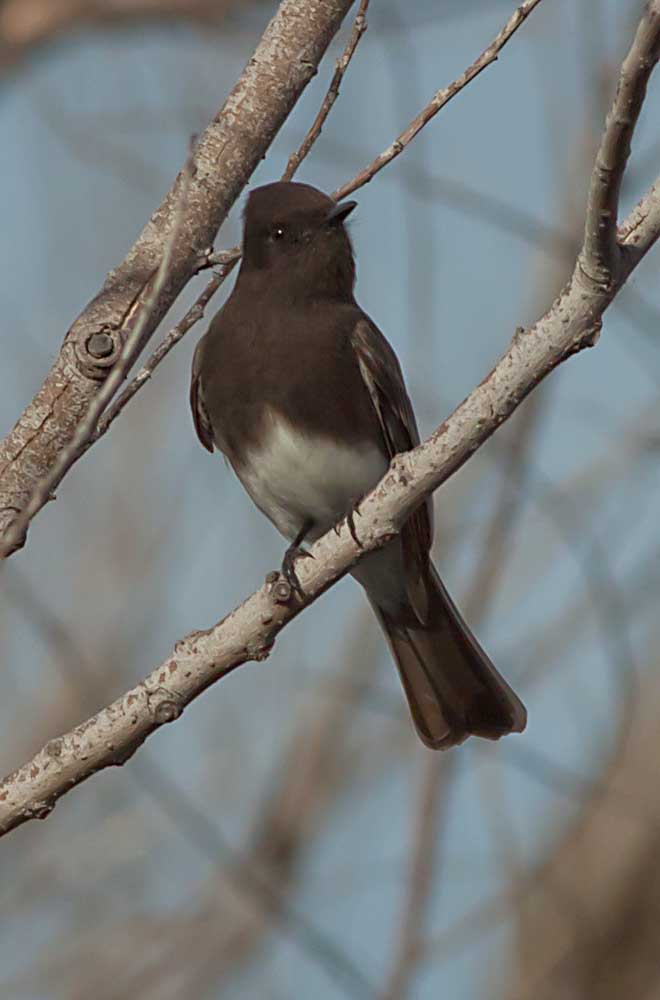
 A Black Phoebe landed on a branch.  I do like these little flycatchers, they look so dapper in their cut-away coats.  I enjoy watching them flit off their perch to hawk insects out of the air.

I saw Mallards, Pied-billed Grebes and Egrets but no sight of the otter.
Wait, I see ripples, something is swimming!

That's not a river otter, it's a muskrat.  He came closer and closer, presenting me with a problem I've never had before in photographing wildlife.  He came so that my lens couldn't focus!  I kept having to back up.  He was only about five feet away when he finally noticed me and moved away.
On my way back to the car I spotted a flash of white in a small pond.  Training my lens on the pond I saw not one but two pair of Hooded Mergansers!  Aren't they cute? 
They were quite a ways away but my lens didn't fail me.  I'm pleased with the images but still hope to do better.  I will keep looking, hoping for a closer shot.

To find more views of our wonderful world, go to Our World, Tuesday, hosted for us by Arija, Gattina, Lady Fi, Sylvia and Sandy.

To find more images of birds, check out World Bird Wednesday, hosted for us by Springman.

Monday, January 30, 2012

More Than Sandhill Cranes

Sandhill Cranes may have been our focus on our recent birding expedition to the Delta but they certainly weren't the only birds we saw.  Good Crane habitat is good habitat for a variety of species.
Tundra swans and geese enjoy the flooded fields as well.  But what kind of geese?
My first thought was that this goose, right behind the swans, was a Canada Goose although it seemed rather small and stocky.  When I read Eileen's post about the Brants I decided I needed to take another look.  No, not a Brant.  I went to one of my favorite sources, the Cornell site.  Here I learned about a newly recognized species, the Cackling Goose.  This guy seems to meet the criteria, smaller and with a shorter neck and bill than the Canada Goose, and with the white neck band, which is more common with the Cackling Goose.  There were several of these little guys.
In another field I spotted some little ducks in the distance, moving away as fast as there little feet could paddle.  Downloaded to the computer and cropped I saw that they were Ruddy Ducks, the first I have seen this year.  
In the irrigation ditch beside the road was a Snowy Egret.  We watched him as he used his big yellow feet to stir up the mud, looking for food.
Feeding in the same ditch was this Greater Yellowlegs.  He seemed to be using a similar technique to find food.
A Great Egret and Blue Heron took a siesta in a field.
Down the road some Curlews were foraging.


I know I've shared several images of Kestrels but here is one more.  My best yet and I doubt I will ever do better of a Kestrel in the wild.


Your can find more views of our wonderful world at Our World, Tuesday, hosted for us by Arija, Gattina, Lady Fi, Sylvia and Sandy.
Find more birds at World Bird Wednesday, hosted for us by Springman

Monday, January 23, 2012

Sandhill Cranes

We recently took a couple of birding trips to view Sandhill Cranes.  Though I wasn't pleased with the images on either trip, I will share some of the best.
There are several places in the Central Valley of California to view the Cranes in Winter.  One area, called Staten Island, is owned by the Nature Conservancy and managed to benefit wildlife.  Here Cranes, Geese, Swans, Ducks and other birds can be found foraging in the flooded fields.
 Observing behavior is the most interesting part of viewing wildlife.
 It is not just to see the animals but see them interacting with the environment and each other.
If you watch the cranes for any time you are sure to see some interesting interaction.
Not far from Staten Island (an island formed by rivers and canals) is the Woodbridge Ecological Preserve, our next stop.
Wave goodnight, Gracie
 As the sun was setting, it seemed to draw the cranes attention, it was time for them to head to their night time roost.  The crane's foot does not have grasping toes as do herons and egrets so they head to water for the night.  If they stayed in the fields they would be prey for the coyotes and bobcats.
Find more views of Our World at Our World, Tuesday, hosted for us by Arija, Gattina, Lady Fi, Sylvia and Sandy.

Find more birds at World Bird Wednesday, hosted for us by Springman.

If you find yourself in the Sacramento San Joaquin Delta in winter and want to know where to view the cranes, Staten Island is here and the Woodbridge Ecological Preserve here.  Good viewing can be found along Woodbridge road, not just at the view platform. 

Tuesday, January 17, 2012

Take Off

On a recent birding expedition to view Sandhill Cranes I spotted a beautiful Redtailed Hawk.


He was sitting on the cross arm of a power pole.  He looked like a rufous dark morph and was very striking when in flight.  Unfortunately, I didn't capture the underparts in these images but my impression was they were reddish.

As you might expect, he didn't care for my attention.


Get ready
Go!
And he's off
I say "he" but it well might have been female for it seemed to be quite large.
Off it soared.  I had a hard time keeping it in my view.  My new 400 mm is not image stabilized and the bird was so close that it filled much of my image.  All that said, I was mostly pleased with this series.
Isn't it a beautiful bird?

You can find more birds at World Bird Wednesday, hosed for us by Springman.